The 2026 Stanley Cup Has Been Won. Most Hockey Fans Are Miserable. Everything Is Fine.
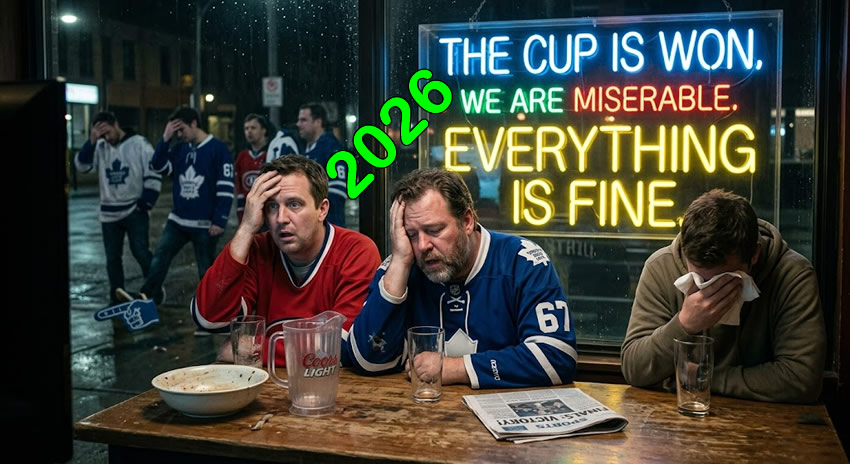
Another NHL season is over. One fan base gets a parade. Everyone else gets opinions.
The Stanley Cup has been awarded.
Somewhere, champagne is being sprayed in a locker room. Somewhere else, a fan is still watching a replay from May, convinced the referee missed the call that changed everything.
The beautiful thing is that both people think they’re having a completely rational evening.
That’s hockey.
The NHL season always ends the same way. One team wins. One city celebrates. Thirty-one other fan bases immediately begin explaining why next season will be different.
And honestly, that’s why we love it.
The funny part is that the championship itself is often the least interesting thing about hockey. The real story is the emotional wreckage left behind.
Think about it.
An entire season lasts more than eight months.
Thousands of hits.
Thousands of goals.
Thousands of bad coaching decisions discussed by people whose own leadership experience involves organizing a barbecue.
Then it all comes down to a handful of playoff games where a puck can bounce off three players, a referee’s skate, the glass, somebody’s shin pad, and suddenly become the most important goal of the year.
Imagine explaining hockey to someone who’s never seen it.
“So the championship was decided by skill?”
“Mostly.”
“Strategy?”
“Partly.”
“Preparation?”
“Sure.”
“What else?”
“Well… the puck hit Kevin in the ankle.”
“Who is Kevin?”
“Nobody knew before Tuesday.”
That’s hockey.
The playoffs are particularly wonderful because they transform perfectly normal adults into conspiracy theorists.
Every spring, millions of people become experts in high-sticking, goalie interference, holding, slashing, boarding, roughing, charging, and whatever rule was ignored thirty-seven seconds before the game-winning goal.
Referees are probably the most famous people in hockey who nobody actually wants to be famous.
No official has ever made a perfect call according to both fan bases.
Scientists should study this.
A referee can make the correct decision according to the rulebook, supported by video evidence, approved by the league office, confirmed by independent observers, and still be accused of criminal behavior by 20,000 people before reaching the parking lot.
It’s almost impressive.
Then there are the goalies.
Nobody understands goalies.
Not coaches.
Not teammates.
Not fans.
Possibly not even goalies.
For six months they’re ordinary professional athletes.
Then the playoffs arrive and suddenly they’re stopping pucks with parts of their body they didn’t know existed.
A goaltender can spend an entire season looking merely good.
Then one playoff round begins and he turns into a combination of a brick wall, a chess grandmaster, and a medieval wizard.
The opposing team records 47 shots.
The goalie allows one goal.
Reporters call it a great performance.
The losing fan base calls it a personal attack.
Meanwhile, hockey players remain the toughest and strangest athletes in professional sports.
Every postseason ends with injury reports that sound less like sports updates and more like emergency room summaries.
Broken fingers.
Separated shoulders.
Torn ligaments.
Missing teeth.
And somehow the player was still averaging twenty minutes a night.
A hockey player can block a slapshot traveling 100 miles per hour with his foot, limp to the bench, return three shifts later, and then apologize for not playing better.
Normal humans call an ambulance when they sleep awkwardly.
Hockey players call that a maintenance day.
And yet despite all the pain, frustration, heartbreak, controversial calls, overtime losses, and impossible saves, fans keep coming back.
Because deep down we know the secret.
Sports aren’t really about winning.
If they were, most fans would quit.
Sports are about possibility.
Hope.
The completely irrational belief that next year might be different.
That your rookie might become a star.
That your team finally solved its problems.
That your general manager knows what he’s doing.
Okay, maybe not that last one.
The point is that hockey sells hope better than almost anything else.
And hope is undefeated.
The Stanley Cup winner today won’t necessarily be the Stanley Cup winner next year.
A great team can become ordinary.
An ordinary team can become great.
A backup goalie can become a legend.
A fourth-liner can score the biggest goal in franchise history.
That’s why the offseason matters.
That’s why fans immediately start looking ahead.
The season ends, but the dreaming never does.
Soon we’ll have free agency.
Trades.
Draft picks.
Training camps.
Bold predictions.
Terrible predictions.
And the annual tradition of every fan base convincing itself that this is finally the year everything comes together.
Maybe it will.
Maybe it won’t.
Either way, we’ll watch.
The Cup has been awarded.
The arguments have already begun.
The next season is closer than it feels.
And somewhere tonight, a hockey fan is saying the same thing hockey fans have said for generations:
“Just wait until next year.”
The funny thing is that one day, they’re right.