The Knicks Won the 2026 NBA Title. Most Fans Are Mad Anyway.
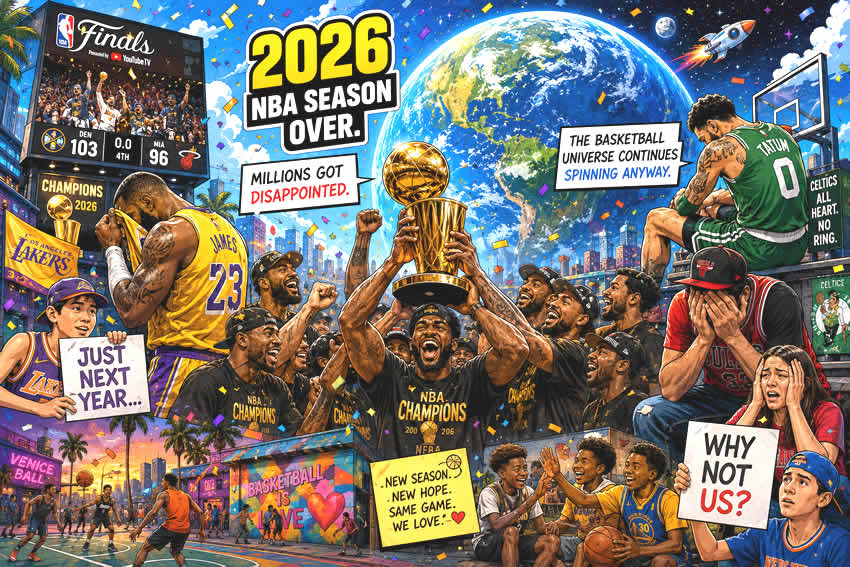
The season is over. Somebody got the trophy. Millions got disappointed. The basketball universe continues spinning anyway.
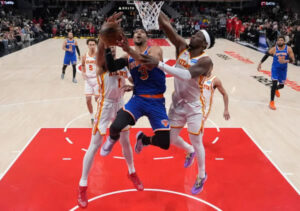
The 2026 NBA season is over, and the New York Knicks are champions.
Some fans are celebrating in the streets. Some are staring silently at box scores from three weeks ago, convinced one missed rebound altered the course of human history. Others are already posting mock drafts, trade ideas, and conspiracy theories involving referees, television ratings, and the moon.
In other words, basketball is healthy.
The Knicks defeated the San Antonio Spurs 4-1 in the NBA Finals, closing the series with a 94-90 road victory. After decades of frustration, near-misses, rebuilding projects, re-rebuilding projects, and rebuilding the rebuild of the rebuilding project, New York finally climbed the mountain.
And the funny thing about mountains is that once somebody reaches the top, everyone immediately starts talking about next year’s mountain.
That is sports.
That is life.
That is also why NBA general managers probably age faster than normal people.
The Knicks’ championship run was not built on glamour. They were less Hollywood blockbuster and more stubborn taxi driver. Every game felt like they were collecting small advantages the way some people collect parking tickets. Offensive rebounds. Loose balls. Defensive stops. Possessions that looked ugly enough to require legal representation.
The basketball equivalent of winning arguments through persistence.
Their opponents spent months trying to solve New York and eventually discovered that New York was less a basketball team and more a recurring inconvenience.
Meanwhile, the Spurs arrived in the Finals looking like the future.
Young stars. Smart basketball. Excellent coaching. A roster that looked assembled by people who enjoy spreadsheets and making good decisions.
Unfortunately, the NBA has a cruel sense of humor.
The future arrived early and then ran directly into the present.
The Spurs were supposed to be the story.
The Knicks became the ending.
Somewhere, a basketball analyst is currently deleting a prediction article while pretending he never wrote it.
Speaking of predictions, the playoffs once again proved that experts know approximately the same amount as weather forecasts.
Every round began with certainty.
Every round ended with confusion.
Teams that looked unbeatable suddenly forgot how to shoot.
Teams that looked finished suddenly became dangerous.
Players who spent six months being criticized suddenly turned into heroes.
Players who spent six months being praised suddenly discovered the internet can be a very unfriendly place.
The playoffs are essentially a three-month reminder that confidence and accuracy are not the same thing.
Then there are the referees.
Ah yes, the true stars of every postseason according to social media.
Every fan base entered the playoffs believing officials were neutral.
Every fan base exited believing the officials were personally employed by the opponent.
Knicks fans complained.
Spurs fans complained.
Thunder fans complained.
Lakers fans complained.
Denver fans practically opened an independent investigative department.
The remarkable thing is that all of these groups somehow reached opposite conclusions while watching the same games.
This may be the NBA’s greatest achievement.
Creating a product capable of generating universal dissatisfaction at the exact same moment.
Yet despite all the noise, the arguments, the replay reviews, and the endless slow-motion clips featuring somebody pointing angrily at a monitor, the games remained compelling.
Because basketball has always been slightly irrational.
A season lasts eight months.
Thousands of possessions.
Millions of data points.
Advanced metrics.
Player tracking.
Shot charts.
Efficiency ratings.
And eventually the championship often comes down to whether somebody can make a difficult shot while exhausted in front of twenty thousand screaming people.
Imagine explaining that to an alien civilization.
“We spent billions of dollars and developed advanced analytics so we could eventually watch a guy shoot a basketball over another very tall guy.”
The alien would probably nod and say, “Honestly, that sounds entertaining.”
And it is.
That is why we keep coming back.
Not because our team always wins.
Most fans never experience that.
The Knicks are champions today.
Most NBA fans are not happy.
That is just math.
For every championship parade, there are twenty-nine groups of fans explaining why next year will be different.
Some are angry.
Some are hopeful.
Some are already studying salary cap spreadsheets at two in the morning.
A few Lakers fans are somehow discussing free agency before the confetti has even been swept off the floor.
Business as usual.
The funny truth is that disappointment is not a flaw in sports.
It is the product.
Hope sells.
Hope returns every October.
Hope convinces fans that this season will be different.
Hope convinces a rebuilding team that its young core is special.
Hope convinces contenders that one more move changes everything.
Hope convinces everybody that the wheel is about to stop on their number.
And occasionally, it does.
This year it stopped on New York.
Next year it will stop somewhere else.
Maybe Oklahoma City.
Maybe San Antonio.
Maybe Boston.
Maybe a team nobody expects.
That uncertainty is the entire point.
The season ends, but basketball never really stops.
Summer League arrives.
Trades arrive.
Free agency arrives.
Training camps arrive.
Predictions arrive.
Bad predictions arrive even faster.
Then suddenly it is October and everyone is optimistic again.
Even the fans who swore they were done with basketball forever approximately twelve days earlier.
So yes, the Knicks won the championship.
Do we like it?
Some do.
Most do not.
It does not matter.
The trophy has been awarded.
The confetti has fallen.
The debates have already started.
Tomorrow arrives anyway.
The wheel keeps moving.
The games keep coming.
And in a few months, every fan base will convince itself that this is finally the year.
Again.