Lakers Still Lead, But Rockets Have Entered the Chat: A 3–2 Series Suddenly Feels Very Different
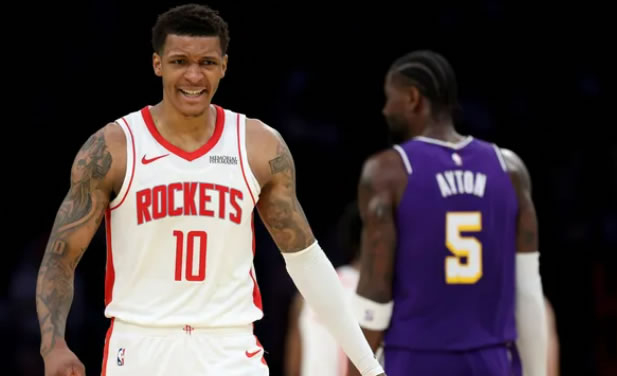
What looked like a routine playoff march has turned into a conversation, and now it is happening on Houston’s terms.
Two games ago, the Los Angeles Lakers were in control of this series against the Houston Rockets, holding a 3–0 lead and the quiet confidence of a team already thinking about the next round. Now, after back-to-back Houston wins, the series sits at 3–2, and the tone has shifted from inevitability to uncertainty.
Momentum in basketball is often overstated, but this feels like one of those moments where it is not imaginary. It is structural.
In Game 5, Houston’s leading scorer finished with 32 points, attacking the rim repeatedly and forcing defensive rotations that had not been there earlier in the series. A secondary ball handler added 21 points and 7 assists, giving the Rockets something they lacked in the first three games: a second decision-maker under pressure. The team shot approximately 48 percent from the field, but more importantly, they generated cleaner looks earlier in possessions.
The Lakers, meanwhile, still produced individually. Their primary star delivered 27 points, 10 rebounds, and 6 assists, while another key scorer added 24. On paper, that should be enough. It was enough in the first three games. It is no longer enough now.
The difference has been in the margins. Houston is playing faster, but not recklessly. They are pushing the ball selectively, turning defensive rebounds into early offense without abandoning structure. In the last two games, they have increased their transition points while also reducing turnovers, a combination that is difficult to sustain but devastating when it works.
The Lakers have responded by slowing the game, leaning into half-court execution and experience. That approach still works in stretches, particularly late in games, but it has become more fragile. When shots do not fall, the offense can stagnate. When the pace dips too far, Houston’s defensive energy begins to dictate possessions.
There is also a subtle psychological shift. The Rockets are no longer playing to extend the series. They are playing as if they expect to win. The Lakers, for the first time, are being asked to close a series that no longer feels routine.
Game 6 now moves to Houston, and that detail matters. Role players tend to play differently at home. Energy changes. Shot confidence improves. Defensive intensity sharpens in ways that are difficult to quantify but easy to recognize.
From a statistical perspective, the trend lines are clear. Houston’s offensive efficiency has climbed over the last two games, while the Lakers’ margin for error has narrowed. Rebounding, once a clear advantage for Los Angeles, has evened out. Turnovers have shifted slightly in Houston’s favor. These are not dramatic swings individually, but together they reshape the series.
The question is whether this is a temporary surge or a real adjustment.
My view is that it is somewhere in between. Houston has made tangible improvements, particularly in pace control and secondary playmaking. Those changes are real. At the same time, the Lakers still possess the most reliable late-game execution in the series. They have been in these moments before, and that experience does not disappear after two losses.
Prediction for Game 6:
Expect a game defined by pace. If Houston pushes early and maintains efficiency, they have a legitimate chance to force a Game 7. The crowd will matter, and their confidence will be high. A stat line in the range of 30 points from their lead scorer, supported by balanced contributions, is realistic if the tempo stays elevated.
However, the Lakers’ path is equally clear. Slow the game, control the glass, and execute in the final minutes. If they keep turnovers low and turn the game into a half-court contest, their experience should reassert itself.
The most likely outcome is a close game, decided late. The edge, slightly, still leans toward the Lakers closing the series, something like a narrow win built on late free throws and controlled possessions.
That said, the series no longer feels predictable. And that, more than anything, is what makes Game 6 interesting.