Spurs Send Blazers Packing (Politely… Then Not So Politely): A 4–1 Series That Felt Like a Pop Quiz Portland Didn’t Study For
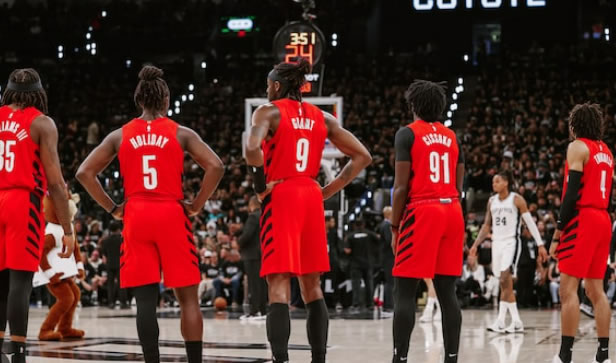
A 4–1 series win that revealed less about highlight plays and more about how disciplined basketball still decides playoff outcomes.
CONTENT:
The San Antonio Spurs did not overwhelm the Portland Trail Blazers with spectacle. They did something far more effective. They controlled the series. In five games, ending April 28 with a 114–95 win, San Antonio demonstrated a version of playoff basketball that often goes underappreciated until it becomes impossible to beat.
This was not a series defined by a single dominant scorer or viral highlight. It was defined by repeatable advantages. The Spurs created better shots, made quicker decisions, and rarely strayed from their structure. Portland, by contrast, often played in reaction rather than intention.
In the closing game, San Antonio’s balance told the story. Their leading scorer finished with 22 points, supported by a primary ball handler who added 18 points and 10 assists, while a frontcourt presence contributed 16 points and 12 rebounds along with interior defense. Six players reached double figures. The distribution was not accidental. It reflected a system that prioritizes reads over roles.
Portland’s production looked respectable on the surface. Their leading scorer posted 24 points, and a secondary option added 17. Yet those numbers required effort that rarely translated into sustained pressure. The Blazers shot around 41 percent from the field in the deciding game, a figure that reflects not just execution, but shot quality. Many of their attempts came late in the clock, often contested, often forced.
Across the series, the gap in offensive philosophy became clearer with each game. San Antonio averaged roughly 26 assists per night, while Portland hovered closer to 20. That difference is not merely stylistic. It is structural. Every additional pass increases the probability of a defensive breakdown. Every isolation possession places a greater burden on individual shot-making. Over five games, those small margins compound.
There were moments when Portland threatened to disrupt the pattern. In Game 5, after falling behind by a significant margin, they mounted a brief run that cut into the lead. For a short stretch, the game appeared to shift. Yet even in that moment, San Antonio did not rush or overcorrect. They returned to their sets, slowed the tempo, and reestablished control. It was not dramatic, but it was decisive.
What separates the Spurs in this series is not simply execution, but clarity. They understand how they want to play and rarely deviate from it. Their possessions have purpose. Their spacing is consistent. Their decision-making, particularly late in quarters, reflects a team that is comfortable operating under pressure.
Portland, on the other hand, revealed the challenges of a developing team in a playoff environment. They showed energy and flashes of creativity, but lacked the secondary playmaking and defensive consistency required to sustain success over multiple games. When their primary options were contained, the offense often stalled. When rotations broke down defensively, San Antonio capitalized without hesitation.
The broader takeaway from this series is not that the Spurs are flawless, but that they are reliable. In playoff basketball, reliability can be more valuable than brilliance. It reduces variance, limits mistakes, and forces opponents to play near-perfect games to keep pace.
San Antonio did not need to be extraordinary to win this series. They needed to be consistent. That consistency, built on ball movement, spacing, and composure, proved more than enough.
As the playoffs continue, the question is not whether the Spurs can produce highlight moments. It is whether their opponents can disrupt a system that, so far, has shown very few cracks.