Stars Outlast Wild in Double Overtime Thriller 4–3 as Johnston Plays Hero
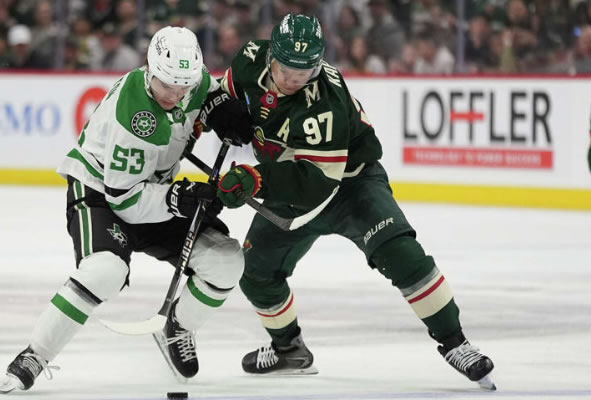
Dallas survives a marathon Game 3 behind clutch performances while Minnesota is left with a brutal “what if”
The Dallas Stars didn’t just win Game 3—they endured it. A dramatic 4–3 double overtime victory over the Minnesota Wild gives Dallas a 2–1 series lead, but the real story is how it happened. This wasn’t a clean win. It was messy, exhausting, and decided by inches after nearly two full extra periods of hockey.
Let’s start with the real numbers—because this game had stars performing like it actually mattered.
The hero of the night was Wyatt Johnston, who scored the game-winning goal in double overtime on a power play—his third goal of the series. It wasn’t flashy, just a perfect deflection at the right time, but in a game like this, timing is everything.
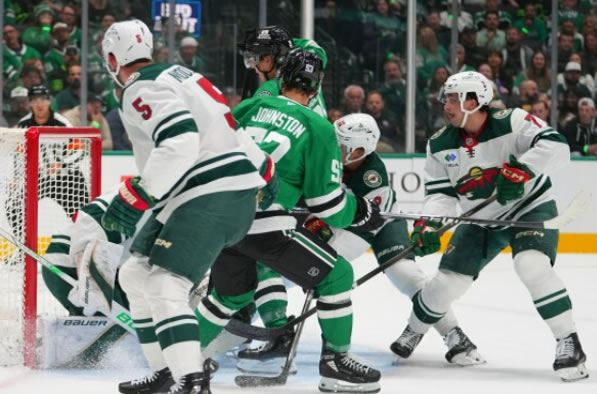
But Johnston wasn’t alone. Matt Duchene and Jason Robertson both delivered huge performances, each finishing with 1 goal and 2 assists. That’s three-point nights in a playoff game that went into double overtime—basically carrying the offensive engine for Dallas. ()
And then there’s Mikko Rantanen, who added 1 goal and 1 assist, quietly contributing in key moments. This is what makes Dallas dangerous—it’s not one player, it’s waves of production. ()
Between the pipes, Jake Oettinger delivered when it mattered most, stopping 28 of 31 shots. Those numbers don’t scream dominance, but context matters—he made key saves late, especially as fatigue kicked in and mistakes became more likely. ()
On the other side, the Minnesota Wild didn’t just roll over—they pushed Dallas to the absolute limit.
Goals came from Marcus Johansson, Joel Eriksson Ek, and Michael McCarron, who scored his first career playoff goal—a moment that should have been bigger, if the result had gone differently. ()
In net, Jesper Wallstedt was under constant pressure and still managed to stop 32 of 36 shots, keeping Minnesota alive far longer than expected.
But here’s where the game really shifted—special teams.
Minnesota went just 1-for-7 on the power play, and that’s where the difference shows. In a game this tight, you don’t get seven chances without capitalizing. Meanwhile, Dallas scored the biggest goal of the night on the man advantage. That’s the series right there. ()
From a flow perspective, Dallas actually started strong, jumping out to a 2–0 lead in the first period. That should have been control. Instead, Minnesota fought back, tying the game and eventually pushing it into overtime. ()
And that’s what makes this game so brutal for the Wild—they didn’t collapse. They competed. They adjusted. They matched intensity for over 80 minutes of hockey.
They just didn’t finish.
From an analytical standpoint, this game tells you a lot about both teams.
Dallas is built for this. Depth scoring, composure under pressure, and the ability to execute in key moments. When games get long and chaotic, they don’t panic—they simplify. That’s a dangerous trait in the playoffs.
Minnesota, on the other hand, is right there—but missing that final edge. The effort is there, the structure is there, but execution in critical moments isn’t consistent enough yet. And in games like this, that’s everything.
There’s also a mental impact that doesn’t show up in the box score.
Winning a double overtime game gives Dallas more than just a 2–1 lead—it gives belief. They now know they can survive anything Minnesota throws at them.
For the Wild, this is the kind of loss that lingers. You play nearly two full extra periods, you match everything, and you still walk away empty. That’s not just physical fatigue—that’s mental weight.
Looking ahead, Game 4 becomes massive.
Dallas has momentum, confidence, and a system that’s working. Minnesota has urgency—and probably some frustration. The key question is whether they can turn that frustration into execution.
Because if this series continues to come down to moments, Dallas has already shown they know how to win them.
Game 3 wasn’t just a thriller. It was a turning point.